Why the Body Is the Missing Piece in Your Brainspotting Sessions
Apr 15, 2026
I have been a licensed clinical social worker since 2010, and I spent the first six years of my private practice doing traditional talk therapy through diagnostic models, treatment planning, the kind of work I was trained in and genuinely believed in, and then I burned out.
Not the kind of burnout that shows up as exhaustion, although that was there too. The kind that shows up as a growing sense that something essential was missing. That the work I was doing was good, but not quite reaching the places it needed to reach. That my clients were making progress, but something deeper was staying untouched.
In 2016 I started doing yoga therapy for my own healing, and everything changed. Not overnight. But gradually, undeniably. I started accessing parts of my own experience that years of talk therapy had circled around but never quite reached. And I realized, this is getting to the pre-verbal, the stored, the places where the real material lives.
I wanted to offer that to my clients. So I trained for two years in Phoenix Rising Yoga Therapy and graduated as a Certified Yoga Therapist in 2017. And then I found Brainspotting.
Why These Two Modalities Were Made for Each Other
When I encountered the nine principles of Brainspotting, I had an immediate recognition. Non-directive. Client-led. Oriented toward the nervous system’s own intelligence. Holding uncertainty as sacred space. Following the tail of the comet rather than leading the session toward a predetermined outcome.
These are the exact principles of yoga therapy.
Both modalities work below the level of conscious thought, honoring the body as an essential part of the healing process, trusting the client’s internal wisdom to guide the work, and both are what we call bottom-up processes, working from the body and nervous system upward, rather than from the thinking mind downward.
In yoga therapy, we use what we call edge work, taking a sensation or held pattern to the edge of comfortable intensity, not to force it open, but to explore what is there. To listen to what that part of the body wants to communicate. In Brainspotting, we use a fixed eye position to access the subcortical brain and open the file. The two approaches are doing the same thing through different doorways.
When I started combining them in my sessions, the results were not subtle. Clients who had been circling the same material for months broke through. The depth of processing increased dramatically. And I started leaving my office at the end of the day feeling more alive, more connected, and less depleted than I had in years.
That experience became the Yothera Method.
What Most Therapists Are Missing
Here is something I say with genuine compassion, because I lived it for years: most therapists are working from the neck up.
We were trained in a model that privileges the mind. That rewards cognitive frameworks and verbal processing and the ability to stay composed and in control while our clients do their work. And we absorbed that training so completely that many of us have become, as I sometimes say, talking heads, genuinely skilled, genuinely caring, and genuinely disconnected from our own bodies in the room.
This matters clinically. Not just for our own wellbeing, although it absolutely matters there too, but because the quality of presence we bring into a session is directly shaped by our relationship with our own body. You cannot take a client somewhere you have not been. If your own embodiment is limited, your capacity to hold attuned, embodied space for your clients is limited too.
The good news is that this is changeable. And it does not require a two-year yoga therapy training to begin.
Four Ways to Start Bringing the Body In
In my workshop and in my own practice, I teach yoga therapy tools across four windows of a Brainspotting session: before processing, during focused mindfulness, at pause or overwhelm, and after processing.
If you are brand new to this, I suggest starting with before. Just three to five minutes at the beginning of a session, before the pointer comes out and the eye position is found. Something as simple as: closing the eyes together, noticing points of contact, taking three deep breaths with longer exhales, doing a slow body scan. That is yoga therapy. And it changes the quality of what follows in ways that are immediately noticeable.
You can also invite movement during processing. This is one of the things I feel most strongly about, and one of the things most therapists do not know is available to them: clients do not have to stay still in a Brainspotting session. The eye position opens the file. The file stays open. And the body, if given permission to move, to shift position, to make sound, to follow what it needs, often does exactly what is needed to move the material through.
Front-loading this at the beginning of a session makes all the difference. Before you find the eye position, you can simply say: just so you know, you are free to move, shift position, stand, make sounds, whatever your body needs during our session today. That single sentence changes the container for everything that follows.
I want to say something that I believe is the most important piece of all of this, and the part that is most often skipped in continuing education conversations.
These tools work in your sessions to the degree that you have practiced them in your own body first.
This is not a moral statement. It is a neurobiological one. Your nervous system cannot offer what it has not experienced. Your capacity to hold an attuned, embodied presence for your clients is built on the foundation of your own relationship with your body, your willingness to feel what is there, to trust your felt sense, to stay present to your own experience rather than managing it out of the room.
This is why every workshop I offer begins with the participants doing the work themselves. Before we talk about clients, before we practice techniques, before we cover any clinical framework, we drop in. We feel it. We let our own bodies have the experience that we are going to offer to the people we serve.
Because that is how this transfers. Not through information. Through embodiment.
Join Me on April 25th
The Yothera Method for Brainspotting is a full day live online workshop for therapists and helping professionals who are ready to bring the body fully into their sessions. We cover the history and clinical framework of yoga therapy, how it maps onto the nine principles of Brainspotting, and practical beginner-friendly tools you can begin using immediately.
Workshop Details
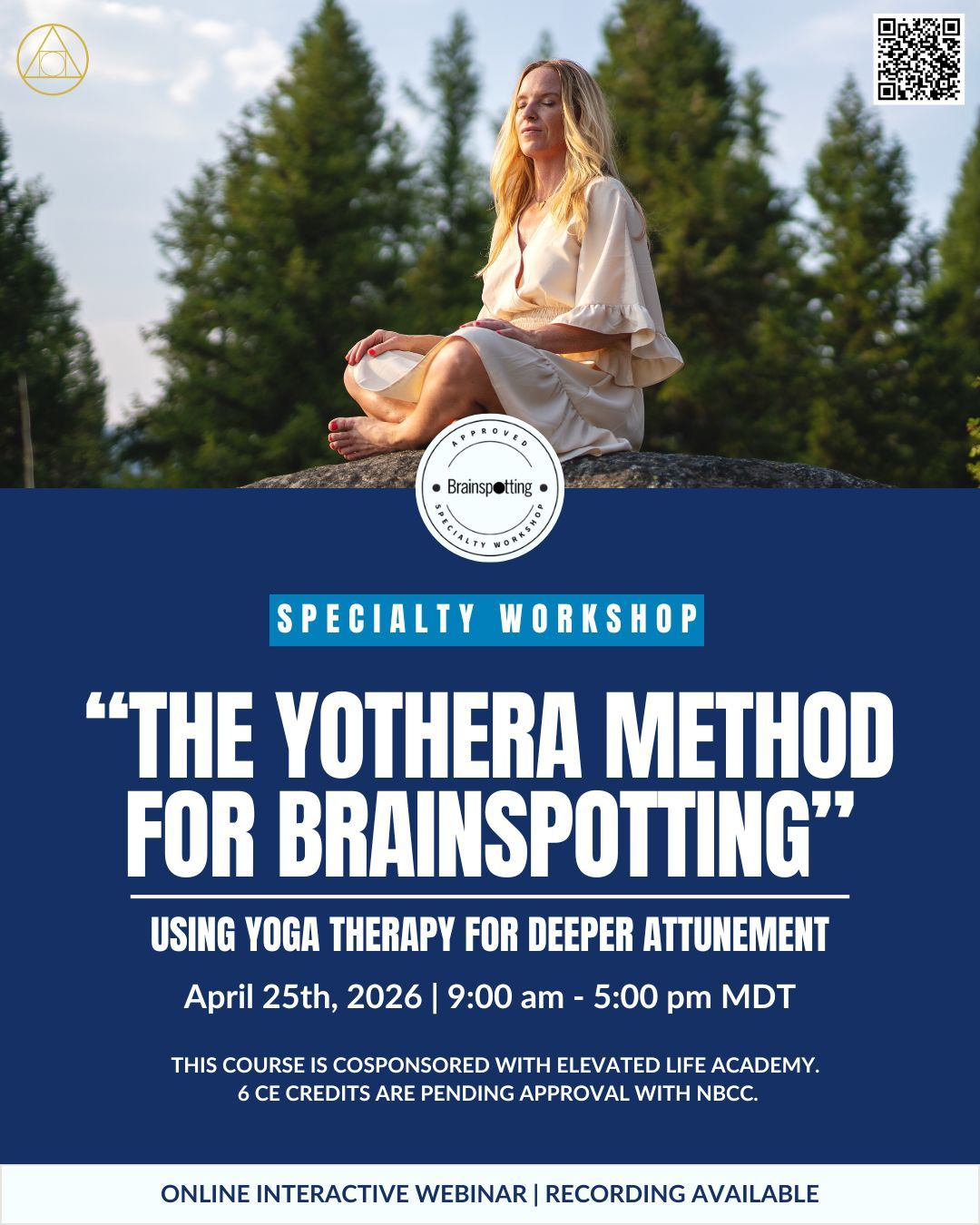
We practice together. We do group yoga therapy and Brainspotting experiences. We use breakout groups to make the work your own. And I do a live demo of a full integrated session with a debrief.
This workshop is approved for 6 continuing education credits. Recordings will be available. No yoga experience needed. No Brainspotting requirement.
Last day to enroll is April 23rd.
If something in this piece resonated, if you felt the recognition of something you have been sensing but haven’t had language for, this workshop was written for you.
I hope to see you there.